Deel: What Singapore’s Gen Z workers want in 2026
Deel's latest whitepaper reveal how employers can meet the changing expectations of Gen Z in Singapore
Generation Z in Singapore is changing workplace priorities. Workers aged 14 to 29 now make up around 13% of the country’s 2.4 million-strong labour force, bringing digital-first habits and different modes of working.
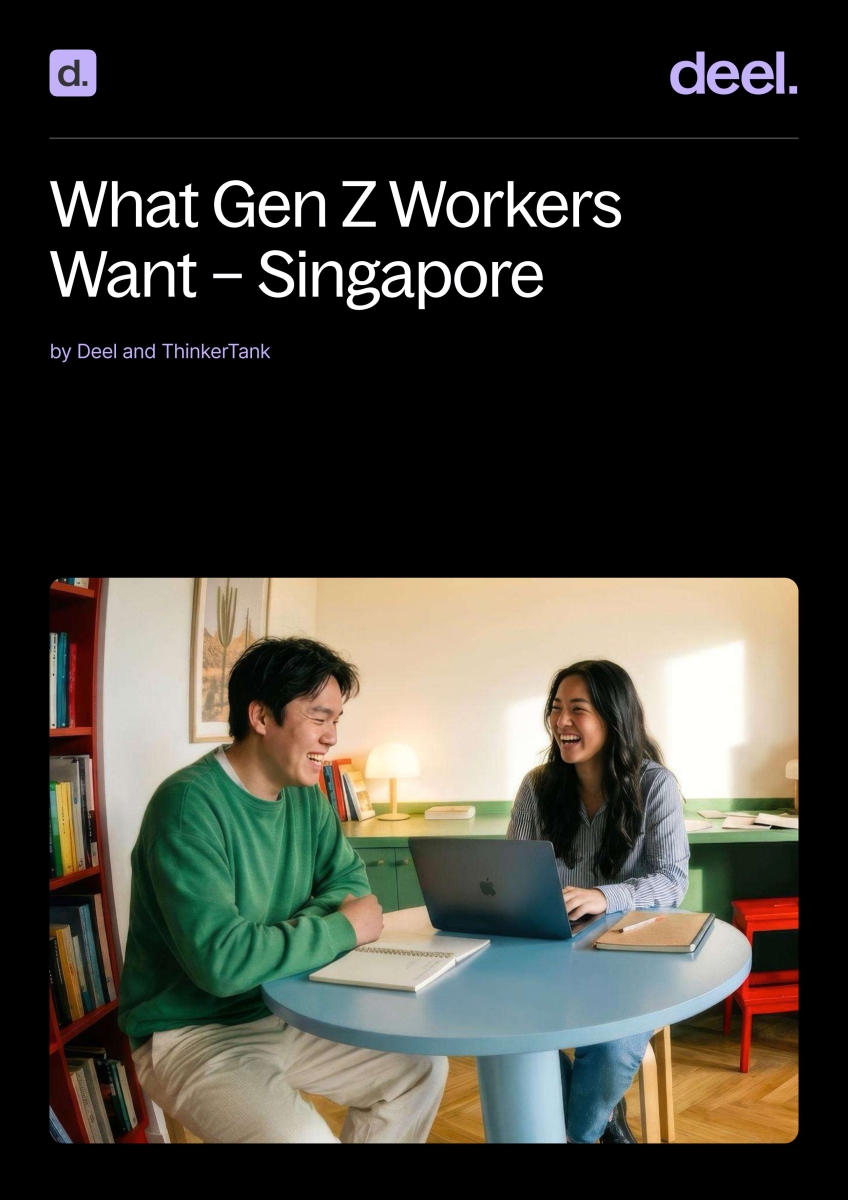
As they joined the workforce amidst the rapid rise of artificial intelligence (AI), many have already started to use technology to increase productivity. But their priorities go beyond electronic devices. They also consider whether they receive fair pay, dependable paychecks, and efficient workplace processes.
The study, “What Gen Z Workers Want 2026 – Singapore,” commissioned by Deel and conducted in partnership with YouGov and ThinkerTank, explores what this generation is looking for and how employers can adapt.. A total of 1,045 working adults in Singapore aged 18 to 29 participated in the study and provided insights into the hopes and obstacles that are defining this generation.
As Karen Ng, Regional Head of Expansion – Enterprise – North and South Asia at Deel, noted in an interview with Singapore Business Review, the findings highlight the need for organisations to rethink how they support their workforce.
Shadow AI - Balancing adoption with governance
Nearly half of Gen Z respondents (49%) said they had achieved productivity gains from using AI, higher than the 33% reported in Australia. Meanwhile, only 9% remained outside the AI conversation. This suggests that young workers in Singapore are not simply waiting for organisations to introduce new technologies such as AI. In fact, many are already incorporating it into their daily routines to work more efficiently.
“Gen Z views AI as a practical necessity rather than an experimental novelty. Young Singaporeans are pragmatic, and they are adopting AI independently to protect their personal boundaries and deliver quality output without burning out,” Ng said.
Yet technology adoption is outpacing workplace governance, with much of this use occurring through personal devices and without employer monitoring.33% reported using personal devices to perform work tasks related to AI, while 19% use it more than their employers know. Only 13% report that their AI usage was monitored.
This indicates an increasing problem of shadow AI, where employees use tools without organisational oversight or guardrails for responsible use.
Rather than banning AI, Ng believes employers should set clear guidelines and provide approved tools. “Organisations should replace ambiguity with transparent frameworks by setting clearer rules and fostering an open culture where safe adoption is guided rather than penalised.”
Payday perils

Beyond technology, the research also highlights more fundamental workplace concerns. 72% of respondents prioritised pay that keeps pace with living costs as a top job consideration, ahead of flexibility (51%) as well well as learning and career development (49%).
Yet, 71% have experienced at least one form of payroll or administrative friction at work. One in five (21%) reported being paid late, and 15% had found a mistake in their pay. Late payments were more common amongst respondents earning less than SG$3,000 monthly (33%), compared with 17 to 22% in every income band above that.
Administrative processes also remain a source of frustration. Nearly a third (31%) still have to print, sign, and scan documents, and 26% have had to provide personal information to their employer more than once. Meanwhile, 22% waited more than a week for a laptop or system access.
“Compensation is the baseline of the psychological contract between employer and employee. When payroll runs smoothly, it is invisible. But when it fails, it instantly dismantles trust between employee and employer.Simply put, Gen Z expects friction-free digital workflows—and increasingly, the rest of the workforce does,” Ng explained.
Building employee trust with workplace infrastructure
For employers, addressing these concerns means looking beyond individual administrative fixes. Payroll, onboarding, and IT provisioning are interconnected parts of the employee experience, and delays in any of these areas due to a lack of proper infrastructure or systems can affect productivity and trust.
Deel's Global Payroll helps organisations manage payroll across markets through a single dashboard for payments, currencies, and compliance. Its automated workflows, real-time calculations, and unified reporting across entities and currencies help reduce manual work, minimise delays, and improve payment accuracy whilst supporting compliance with local regulations.
Meanwhile, Deel IT helps businesses manage IT vendors and regional partners, track assets in real time, and coordinate equipment delivery across locations. Its device management capabilities also connect hardware provisioning with HR onboarding, allowing organisations to procure, pre-configure and deliver equipment, as well as automate retrieval and data wiping when employees leave.
Together, these solutions help businesses streamline workforce operations and provide employees with more consistent support. As organisations adapt to changing workforce expectations, the challenge is not simply to adopt more technology. It is to ensure that the systems supporting employees are reliable and fit for the way people work today. Ng further emphasised the importance of investing in workplace infrastructure to build stronger employee relationships and support long-term talent retention.
“A large portion of an employee's day is dedicated to the workplace. When workplace infrastructure falls short, trust can quickly erode. Organisations therefore need to keep pace with evolving workplace demands and technology,” Ng said, “To sustain a strong future talent pipeline, particularly amongst Gen Z, organisations must invest in infrastructure that best supports their employees.”
To learn more about Deel and its global workforce solutions, visit https://www.deel.com/.


























 Read Here
 Advertise
 Sign Up