Weak leasing deepens divide in retail property market
Savills forecasts 1%-2% rental growth for Orchard Road and suburban malls in 2026.
Weaker islandwide leasing demand is expected to widen gap between stronger and weaker retail assets, even as rents hold up at Orchard Road and dominant suburban malls, according to Savills Singapore’s third-quarter (Q3) 2026 retail briefing.
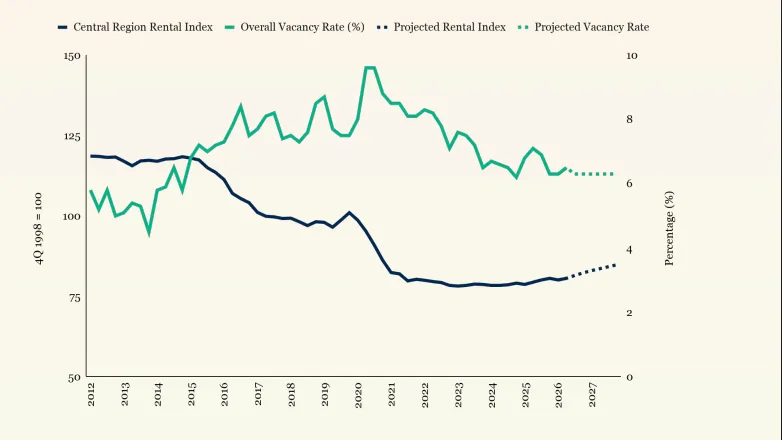
Orchard Area mall rents edged up 0.4% quarter on quarter to $23.80 per square foot (sq ft) a month, whilst suburban mall rents rose 0.2% to $15.00.
Rents in the Fringe Area, which covers locations in the Central Region outside the Central Area, fell 0.7% on softer demand.
Islandwide net take-up was at -226,000 sq ft, an improvement from -398,000 sq ft in Q2. Vacancy is stable at 6.5%, supported by a 215,000 sq ft net reduction in retail space in the Central Region.
Orchard Area was the only part of the Central Region to record positive net take-up, at 11,000 sq ft. In the Suburban Area, net take-up turned positive at 75,000 sq ft, lowering vacancy to 4.4% from 4.7%.
Savills forecasts rental growth of 1% to 2% in 2026 for both Orchard Road and suburban malls, expecting limited new supply to support occupancy and rents, particularly for well-located, quality assets.
New retail supply is estimated at 252,000 sq ft of net lettable area this year, well below the 2021-2025 annual average of 474,000 sq ft, with 264,000 sq ft of completions projected in 2027.
Supply is expected to pick up from 2028, averaging 677,000 sq ft a year over 2026 to 2030. Projects in the pipeline include the redevelopments of Tanglin Shopping Centre and Tanjong Katong Complex.
Operating conditions remain tough for retailers, especially food and beverage operators, with more than 24,000 food shops competing for spending, said Savills.
Cinnabon exited Singapore, Hoshino closed two outlets and Crystal Jade ceased operations at four locations. Savills said spending is concentrating on a narrower group of brands, so “landlords can no longer count on a rising tide to lift all tenants.”
“With consumer spending increasingly concentrated among a narrower group of successful concepts and brands, the retail market is becoming more polarised. In this environment, the quality of asset management will increasingly determine how well retail properties perform,” said Alan Cheong, executive director for research and consultancy at Savills Singapore.



























 Read Here
 Advertise
 Sign Up