Why agentic AI alone will not improve banks without internal change
DBS combined its corporate and consumer call centers due to chatbots’ impact in their processes.
Slapping an agentic artificial intelligence (AI) tool in your banking business isn’t going to automatically improve your business—processes and cultures must also be changed, banking experts said.
Derrick Go, group chief operating officer at DBS, said that in order to properly leverage AI banks will need to modernise their technology architecture, consider data quality, and change the way that teams collaborate within an organisation.
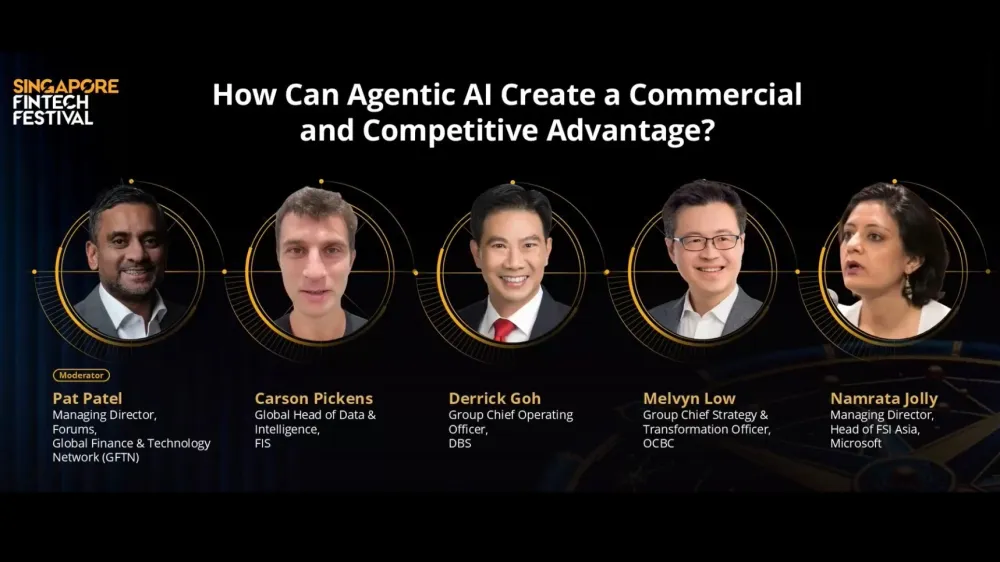
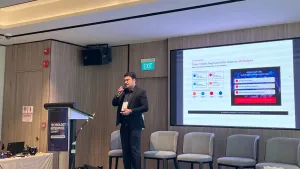
DBS, for example, created a chatbot to bring down the volume of calls fielded by its 1,600 call center staff worldwide, Go told attendees of the panel “How Can Agentic AI Create a Commercial and Competitive Advantage?” at the FutureMatters Stage of Singapore Fintech Festival 2026, 18 November.
Through this, DBS was able to combine its corporate and consumer call center, Go said, which he said enabled the bank to cut costs and keep customers happier as it provides quicker answers for their more complex questions.
“[The call center staff] can do a lot more than what they used to do. They can answer more complex questions than what they used to do, especially those in our consumer call centers. So we are making them pick up corporate calls as well,” Go said in the panel, which was moderated by Pat Patel, managing director, forums, at GFTN.
Melvyn Low, group strategy & transformation officer at OCBC, said that the real opportunity in AI is how it unlocked new ways of thinking within the organisation, from new ways of working to new business models to news products.
“You have to deploy the technology where it's needed to improve your efficiency, but you also have to think about the technology in the context of the world today,” Low said.
Low said that AI must have the right context to operate. He advised businesses to question why processes are done a certain way.
“If you don't understand your processes and why you were doing it, and the common phrase of ‘but we've done this all along’, right, it is not something that you should be looking at. You need to understand why you do something in a certain way, and there's probably many reasons for it,” Low said.
Carson Pickens, global head of data & intelligence for FIS, said that organisations should not shy away from using agentic AI in highly regulated use cases. The most regulated use cases will have the most standard operating procedures and the most documentation, Pickens said.
“Even though they might carry the most risk, they also carry the most context to allow you to effectively build things without having to do all the process mining and process engineering,” Pickens said.
Namrata Jolly, managing director and head of FSI Asia for Microsoft, circled back to Go’s point that using AI does not automatically translate to business value.
Jolly noted how Commonwealth Bank of Australia (CBA) reduced fraud losses by 20% by having AI monitor and scan the 80 million events and 20 million payments it processes daily; and how Northern Trust used agentic AI to bring down client onboard to two days from the previous two and a half weeks’ turnaround time.
Jolly also emphasized building the right culture in an organisation of moving fast, as well as governance.
“You can have the models, right? But you have to have smart drivers. You have to have good fuel, and you also have to have a very good braking system. If you have the right brakes,you can go as fast as required,” she said.
Low said that beyond all, people will be the biggest differentiator in determining the competitive and commercial advantage that agentic AI offers.
“I say people because the source of competitive advantage is proprietary knowledge,” Low said. He cited a recent hackathon by OCBC, where he said the bank was amazed to find that its employees have ideas for the bank’s other divisions, places, and areas of business.
“What it taught me was that if you invest in the right way with your people, give them the right tools, guardrail them within the organization so that you don't lose anything. You probably get the best competitive advantage,” Low said.





















 Read Here
 Advertise
 Sign Up